Brown University Students Cheating with AI
Emma Whitford writes at Inside Higher Ed about the appalling behavior of students in the Welfare Economics and Social Choice Theory course at Brown University. For the first time in 20 years teaching the course, economics professor Roberto Serrano gave his students a take-home midterm exam.
Quite a few students had expressed anxiety about being in a classroom after a gunman killed two students and injured nine in a December mass shooting at Brown, and so “it was appropriate,” he said, to allow students to take their exams at home.
The average score on the take-home midterm was 96 percent.
“Historically the average grade in the midterm of this course has ranged between 65 and 80 [percent], and this exam was harder than the exams I wrote in the past…”
The student responses seemed “fishy” so he and his graders asked ChatGPT to answer the test, and noted striking similarities with what the students had turned in. He changed the final exam to an in-person test.
“I am not declaring [the midterm] void for now. I am going to give the class a chance to prove me wrong,” he wrote. “That is, if the distribution of the final exam is roughly similar to the distribution of the midterm, I will count the midterm. Otherwise, which is of course what I expect to happen, I will declare the midterm void and reweigh the final accordingly.”
Subsequent to his message, 18 of 86 students dropped the class, and 9 more did not take the final exam. Three students earned a zero on the final (and two of those three scored 100 percent on the take-home midterm), and the average score was 48.6 percent. Only one student did better on the final than they did on the midterm.
He published the anonymized student scores: brave, but fitting for an economics professor.
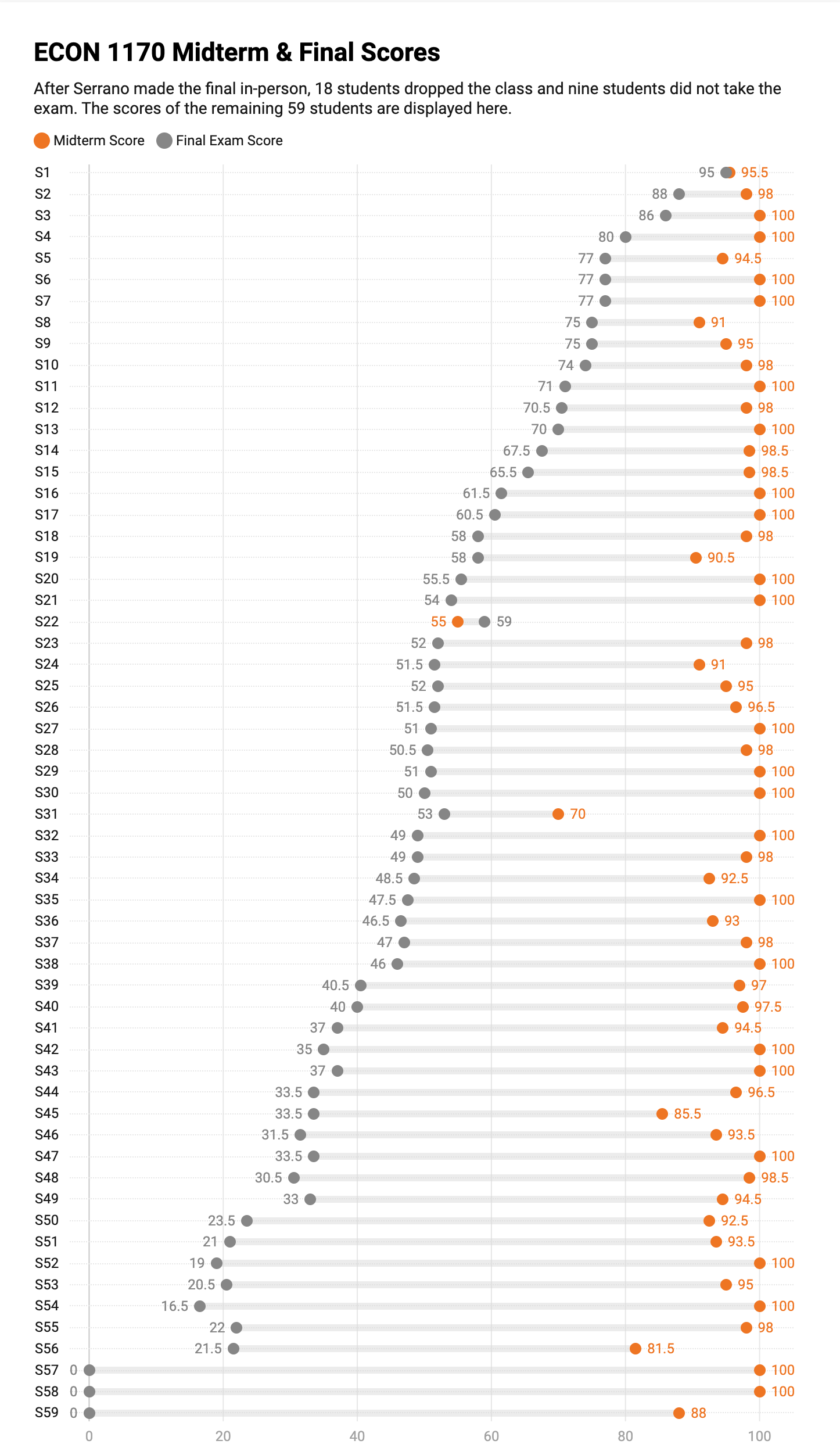
Brown University’s response has been tepid. Here’s what spokesman Brian Clark said:
Brown treats every allegation of academic integrity with the utmost seriousness. In regard to this economics course, multiple academic leaders from Brown were in touch with the faculty member who raised concerns to provide details about how the allegations raised could be formally adjudicated. To date, the faculty member has not provided the necessary details to the Standing Committee on the Academic Code to pursue this path toward resolution.
But the University has taken no action. Professor Serrano submitted this data to Brown’s committee in May and got no response. He went public with his story in late June. Professor Serrano said:
“Their response, I must tell you, is seen as appalling and insufficient by hundreds of people who have emailed me in support, many of them Brown alumni.”
“We cannot afford to have a society in which a significant fraction of our best young minds think that cheating is OK,” he said. “That leads to a declining society, to a failed society… We cannot choose to become idiots.”